Author: ellery twining
-
How to Remove a Memorial
“He stands, today, as every day, in a pose of attack. The sword is being drawn as every sunrise arrives.”
A period of upheaval surrounded the removal of the Major John Mason statue in Mystic, Connecticut. The public discourse around the relevance of the memorial grew heated, and local factions clashed. The result of that discourse was the relocation of the statue. The Mason statue was moved to Windsor, Connecticut—the American hometown of the Major—after pressure from Native groups. The controversy around its removal eventually led to a collective understanding by the local population that their society was far different from the post-Civil War era that created the monument. During the decades following the end of the Civil War, many Americans funded the creation of memorials to lost figures in American history who had participated in the colonization of the US. The citizens of Mystic, Connecticut chose Major John Mason as their historical hero. In 1889, the Mason Memorial, designed by sculptor James G. C. Hamilton, was placed at the intersection of Clift Street and Pequot Avenue.
Mason led a coalition of English soldiers and Native tribes in a coordinated attack on the Pequot settlement at Mystic during the Pequot War of the 1630’s. What ensued was the first large scale military operation on American soil. The Pequot were nearly annihilated in the course of one day. Had it not been for the Pequot warriors who resided at Fort Hill, a few miles away, they most certainly would have.
The conventional wisdom about the battle is that hundreds of men, women and children perished at Mystic because of their lack of defense. But Kevin McBride, former head researcher at the Mashantucket Pequot Museum, determined that the Pequot warriors made the trek from Fort Hill to Mystic just in time to drive the remaining combatants off, chasing them through the nearby wooded area to the west, and then further south toward the coves around the peninsula at West Mystic. Archaeological digs have uncovered evidence that the English and Native coalition was not successful in eliminating the tribe, despite the massacre of over 400 people.
Why did the Pequot need to be forced into submission? They sat on the largest concentration of wampum in the southern colonial settlements, the currency that was at the center of the fur trade, which brought both English and Dutch explorers to the area. The Pequot essentially were The Bank of Southeastern Connecticut.
They were also not looked upon kindly by neighboring Native groups, for that reason and others.
In 1636, the Pequot took to the offensive, attacking settlements at Saybrook and Wethersfield. On the first of May 1637, the Connecticut colony ordered war against the Pequot. Twenty-six days later, the attack at Mystic began.By 1910 there were only 66 members of the Pequot tribe. Today they oversee an international casino empire, and the power which they leveraged in the early 1990s to bring about the removal of the Mason statue was real.
“You cannot alter history…”
Following the tragedy at Charlottesville, I found myself thinking back to 1991, when the residents of Mystic began their discussion about the removal of the Major John Mason statue. Of course, those opposed offered as their central argument that such removal would be “Altering History”. I wanted to remind Mystic about how local debates over the Mason statue had resulted in its relocation. I also wanted to make a public statement about how to move forward with the removal of Confederate memorials. I decided to add a touch of confrontational graffiti to the jersey barriers acting as a replacement guardrail on US Rt. 1, near the Baptist church in town.
WE REMOVED MASON’S STATUE
My goal was to send a message that removing controversial memorials had a precedent, right here in Mystic. I was surprised that the graffiti had been covered by slate grey paint the following day. Undaunted, I decided to return two nights later, to restate the message. After all, I painted graffiti on the original Mason statue in 1990:
AMERICAN FREEDOM FIGHTER
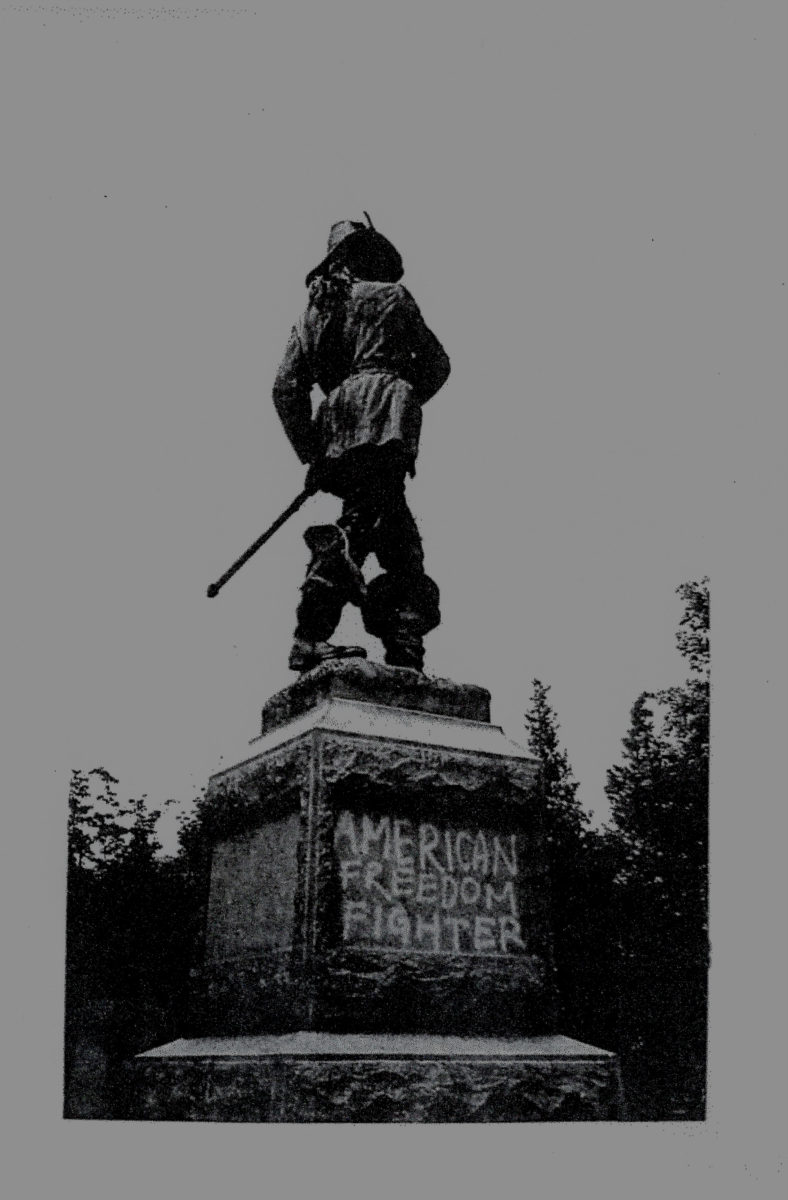
That was during the aftermath of the Iran-Contra scandal, a period when the Freedom Fighter moniker received renewed scrutiny. I returned to the jersey barriers and again sprayed in black paint:
WE REMOVED MASON’S STATUE
The message was again painted over and covered up the next day. I was shocked: it seemed that our community wouldn’t broach the topic that we had defined decades earlier, to help assuage another similar issue in another part of the country. A friend told me that descendants of Mason would have painted over my graffiti. But I was still convinced that Mystic could give our fellow citizens a roadmap toward a future that would represent shared values. Confederate memorials could be approached the way Mystic dealt with Mason. We had already established an historical precedent around the topic.
During the writing of this piece, my research has been two-fold: the resistance to change among the local population regarding the Mason Monument, and how our local controversy mirrors the protests against removing Confederate statues from the public square.
“In his effort to clarify and simplify, noted local historian, William Peterson has stated; ‘Many of us have gotten lost in a forest of peripheral issues …. The implications of removing this statue go far deeper than our own parochial interests. The real issue is not about who was right or wrong in the early 17th century; it is not about justice or injustice; it is not about sacred sites or battle sites; it is not about John Mason or genocide. The merits of these points can be argued (or acted) convincingly and emotionally, but to no one’s satisfaction. The fundamental issue is FREEDOM OF EXPRESSION – one of our basic American ideals! The location of the statue may be insensitive by today’s standards but a past generation could not possibly anticipate the moral persuasions and cultural sensitivities of future generations. The site, the plaque language, and the statue are part of the 1889 expression. The reasons that the site was sacred to the Colonists and their descendants may be different from the reasons given by other people today, but they are no less valid.’ Mr. Peterson believes
“That the statue should remain where it is, unaltered.”“The moral and cultural sensitivities of future generations.”
This is the lesson that the generations before us did not recognize. This is not an accusation. This is a description of an awareness that is an undeniable fabric of modern American life.
The most revealing element was the counter argument from the defendants, as presented by the Mason Foundation during negotiations. The family foundation was surprisingly accommodating at every level of the negotiations, and yet they ended up with no concessions at all.
RECOMMENDATIONS:
We, the members of The Mason Family Memorial Association Inc., being descendants of Major John Mason, do
hereby submit the following specific recommendations to the State of Connecticut.
1. REMOVE ENTIRE STATUE from its present location on Pequot Ave.
2. REMOVE ORIGINAL PLAQUE and loan it to a local museum. Suggested museums: The Indian and Colonial
Research Center, The Mashantucket Pequot Cultural Museum, The New London County Historical Society, The
Mystic River Hist. Soc.
3a. INSTALL STATE HISTORICAL COMMISSION MARKER at the Fort site. b. Promote acceptance and
implementation of Marcus Mason Maronn’s entire proposal for an alternative monument at Pequot Ave. site.
4. RELOCATE ENTIRE STATUE TO HARTFORD, CONNECTICUT. Site on the grounds of the State Capitol or the
State Library.
5a. REBIRTH IMAGE to represent John Mason as a whole person. b. INSTALL NEW PLAQUES as per M.M.M.
proposal.
6. PROCLAIM DAY OF HONOR for Major John Mason.
7. PRODUCE DOCUMENTARY FILM of the entire process for historical and educational purposes.
8. APPOINT M.F.M.A. MANAGEMENT STATUS in regards to J. M. Statue.”
However, their initial stance was confrontational:
“Marcus Mason Maronn has the right idea when he says, ‘We could save a lot of time and energy if the council simply passed a motion to dismiss this entire issue, which has no basis other than the motivation for revenge by certain radical extremists.”Letters to the editor of the local newspaper echoed those sentiments:
“No matter the right or wrong John Mason acted according to the best thinking of the time. What happened, happened. Our monuments and writings must remain undisturbed.”
“I must be dreaming – having a nightmare, that is. An article in The Day is headlined, ‘Groton OKs loan of statue to Pequots.’ Going back in time a little, the Pequot Indians approached the Groton Town Council requesting that the John Mason statue be removed because it was ‘too painful for (them) to look at.’ Now the Pequots are to gain possession of the Mason statue for their own museum? This was a gutless decision by gutless town officials. Only Town Councilor Frank o’Beirne had a grip on reality, stating that he’s “having a hard time understanding how a statue that was offensive to them (where it is located now) … would not be offensive if they put it in their museum.’ Councilor O’Beirne expressed his concern for the welfare of the statue in an earlier meeting, a concern I share. Just how much time do the Indians spend cruising Pequot Avenue, being ‘hurt’ by the presence of an historical monument?”The writers of these letters have attitudes similar to those of people opposed to the removal of Confederate memorials in the South. My southern friends like to remind me that the North is not so innocent.
Chicago. Cleveland. Boston. Philadelphia.
I kept turning it over in my mind, what I might have blocked out at the time, due to a myopic focus on my own expectations toward a certain outcome. The point of view that we cannot remove specific memorials was not isolated to a predetermined understanding of Southern values, but was readily expressed by Northerners during a similarly divisive discussion on inclusion and exclusion. And yet, after all of the arguments, the opinions being stated, historical precedents being presented, our community finally removed the Mason statue.
Mystic, Connecticut can show the nation a road map to the future. Our story can teach others how to remove memorials that create hate and division, through thorough negotiations with all sides represented equally.
The conflict delineates history. American history deserves to be a truthful recitation.
source links: indianandcolonial.org
additional edits by rvljones
-
The Pedestrian
our next door neighbors on Ashby Street
were a decade older than my parents.
they felt an intrinsic responsibility to
impact their wisdom on our young family.
their most consequential advice
was to have our family join
the congregational church
that they belonged to-
in the City of Groton.my Father never attended the services
my Mother ascribed to,
following the recommendation of our respected
neighbors. She was the one to wake up early
on Sunday; to get my brother and me
into the appropriate clothes, and the appropriate attitude
to mingle with the good Christians recommended to my mother.
what i did not know at the time
was that my Father was literally
incapable of attending a church service.the car shuffled to a slow stop;
about a hundred yards from the entrance
to the highway exit that led to our house.“ok, Richie, i need you to walk to Nana’s house,
you know where that is, right? near Ocean View but closer
to the Ice House. do you know where i’m talking about?”our house was located at 56 Ocean View Avenue,
two blocks below the intersection
of US Rt. 1 and the Ocean View Avenue.
Nana was my Father’s best friend’s mother,
Polish for “Grandmother”
my Portuguese Grandmother was known as
Vovo.her residence was my destination;
following the command of my Mother,
at the end of the exit ramp.
a two mile walk was of no consequence
to me- i would have walked as far as
she instructed me to.when i arrived at the home of the Hoinsky Matriarch,
my parents best friends were waiting for me.
“where is Linda?”
“she’s at the entrance to town, at the foot of Exit 89…..
Allyn Street…..”i had walked two miles
in an effort to help my Mother.
no one thanked me for making the trek.
i was an afterthought in the “rescue” of my Mother._____
i was fortunate to be drafted as a nine year old,
added to an expansion team of our Local Little League.
that was not something to bring up
in the schoolyard.at the end of an early season Little League practice, it became apparent
three players waiting for their parents
to arrive late would be revealed.i immediately decided that walking away,
toward the parking lot, that would allow me a certain plausibility.
if i made a run for it…
on my own…the driveway of the Ramada Inne
that sponsored my Little League team
was where my Mother spotted me,
walking alone.
i would catch the yellow of her Volkswagen Bug
out of my peripheral vision,
as she makes an abrupt left turn.“why are you out here? why are you walking
home? why did you leave the practice?” my mother’s voice was forceful,
withholding an inherent terror.i realized that negating a public embarrassment
was paramount, and it did not rest exclusively
within the wealthy families of Mystic.it was an incisive insight.
youth football had a very low
return on investment for a five foot one inch
Portuguese kid;
who would have been a soccer player in Stonington Borough,
but grew up on the Groton side
of the Mystic Village.
few of the neighborhood kids
who participated in Little League Baseball
arrived at that first football practice.
i was there. and i realized that certain families in town,
whose kids participated in Little League Baseball
were not present in this public sphere.the rationale for youth football was
Regional Rivalries;
a clash with a neighboring town
according to an accumulated sense
of self-worth.
the parents against the parents, articulated within the specious
athletic ability
of their children.i was a first round draft pick,
but my mother had yet to arrive
after the practice.
i was petrified to be the last player
in the parking lot, holding the coach up
in an untenable situation.
i decided to simply walk home.
i decided to disappear.
i walked into the woods between the
junior high practice fields,
and our neighborhood; higher up the valley
than the basin.
i felt confident no one would find me
as i followed President Carter’s “Fitness Trail”
built by federal funds,
to encourage a more healthy population.i emerged from the woods,
onto Prospect Avenue.
i was quite scared of the Judson Avenue climb,
toward Ocean View Avenue.
a woman had just set the weekly trash
at the curbside, as i passed in heavy breaths.
a cavalcade of tears.“do you need to call somebody?”
“yeah…. can i call my Mother….?”
“of course you can……”
-
The Bates Woods Monkey House
birthday celebrations
during the decade
of my childhood
revolved around what my parents
could afford.for my sixth birthday, my mother booked an event,
in a private room
off of the main seating area
at the local McDonald’s.
parents could rent a room for a
celebration, and skip the lines
at the counter,
for double cheeseburgers,
or the Happy Meal.we were sheltered under public park structures,
at the second stage of my celebration;
anticipating the rain
which was a frequent factor
of an early June birthday.Bates Woods was a small woodland
park in the neighboring town of
New London. to the kids invited to the party,
it represented the City.
after all, there
was a Monkey House at Bates Woods.
a Zoo.
there was nothing resembling a zoo
in Mystic, especially
if we discounted the mammals
in our public aquarium,
deliberately caged.a picnic commenced. the park grills,
covered in an excess of soot,
were nonetheless utilized.
as the final hot dog,
and the final burger
were slapped onto
the wicker basket plastic plate holders,
the rain announced itself.“hey kids, let’s head
to the Monkey House! you can leave
your plates here
at the table.”my mother, trying to control
the situation,
led the group of us to the Monkey House.
the other moms present had to
deal with the aftermath of a picnic
in the rain.“it’s ok Linda, we can clean this up.
take the kids to see the monkeys!”i could sense the subtext of her statement…..
“i would rather clean up this mess than
deal with the Monkey House.”the structure was built with
cinder blocks, the cages were
anchored into an industrial
definition of confinement.
these mammals were imprisoned,
to maximize my
birthday experience. -
The Neighborhood Fire
during the 1970’s, even in my small riverside village,
a certain social order revolved around
what type of swimming pool
was installed on your property.the scientist who installed the first
solar panels i had ever seen
did not have a pool.
he filled a cheap plastic substitute,
bought at the local discount store,
with cold water from the garden hose.the businessman, who ran a recycling plant,
installed a solar blanket,
to keep their in ground pool
at a consistent temperature.
he openly invited us to swim
and share what his children,
who were our friends,
were privileged to know.my best friends in the neighborhood;
a set of identical twins,
were the fortunate recipients of an
above ground pool-
twice the size my parents could afford.the Eastman’s house was exactly halfway between
my house and the twins.
they also had a pool. it was surrounded by a wooden deck,
and a traditional slat fence where the Eastman’s
had hung a few humorous signs dictated by that
particular decade. the wooden signs were held
by loose framing wire on exposed
nails which were already showing signs of rust.“i don’t swim in your toilet-
don’t pee in my pool.”my family, under some social duress,
bought an entry level pool
at the local discount store.
i was surprised my parents felt a need
to keep up with the Eastmans,
or the Carpenters, or the Peters.
were they actualizing equality,
or an illusion?
perhaps,
it was about their own
reconciliation.the local firehouse was located
a city block from my childhood home.
we were not in a city- however the opening of the firehouse doors,
and the initial blare of the sirens,
were intoxicating to us; the unknowing dictated our attention.
everything would cease
as we tried to catch a glimpse
of the deep red vehicles
as they exited
under the perforated glass walls
that would would ceremoniously rise
after the alarm.the trucks never had to enter
into our neighborhood.in the twilight of this evening,
as i toweled off, pleading
for one last minute in the pool;
we heard the first siren.“they are coming down the Avenue.”
stated my mother, with an unavoidably
specific declaration.
she was correct, as we heard the tires of the firetrucks
grind as they took the right hand turn onto
Overlook Avenue.
ambulances from various districts
began to appear,
the Hoxie Hook and Ladder arrived in support.
as we watched the distress unfold,
we crept closer to the fire.“where is Jeremy? have you seen him?”
i watched my mother ask my father
a question
he had no answer to.
the sirens continued to commandeer
the frequency of an emergency.i suddenly understood their temporary
commitment,
their vows.i followed my mother down the Avenue,
as she began asking anyone in earshot, out of desperation,
“have you seen Jeremy….?”“hey Mom, i’m over here…”
he was standing next to one of the firetrucks,
whose tires towered over him.
“that tire could have killed you!”“i just wanted to watch…”
i walked briskly past the Eastmans driveway,
toward our house,
toward what i anticipated was coming next.i overheard the Fire Chief ask Mr. Eastman if the Fire Department
could drain his pool to fight the fire.